
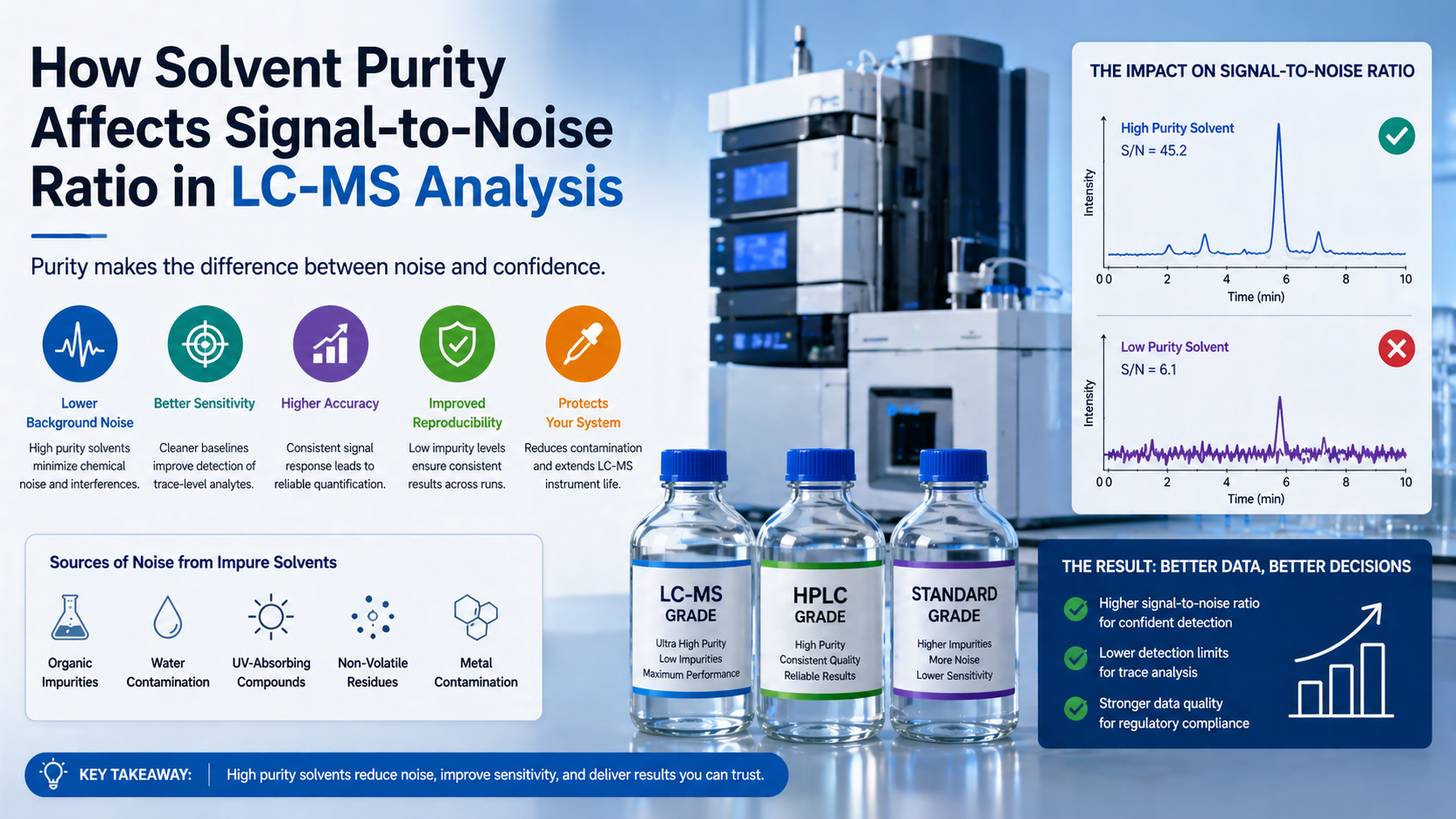
How Solvent Purity Affects Signal-to-Noise Ratio in LC-MS Analysis
Table of Contents
Introduction
Liquid Chromatography–Mass Spectrometry (LC-MS) is one of the most powerful analytical techniques used today. It is widely used in pharmaceuticals, food testing, environmental monitoring, and research labs. The strength of LC-MS lies in its ability to detect compounds at very low concentrations—even at parts-per-billion (ppb) or lower.
However, one critical factor that many people overlook is solvent purity in LC-MS. The quality of the solvent used in LC-MS directly impacts the signal-to-noise ratio (SNR), which determines how clearly an analyte can be detected.
In simple terms:
- Signal = the actual compound you want to detect
- Noise = unwanted background interference
A higher signal-to-noise ratio means better detection, clearer peaks, and more accurate results.
According to analytical studies, improving solvent purity can enhance signal-to-noise ratios by up to 30–50%, especially in trace-level analysis. This makes solvent selection not just important—but essential.
In this blog, we will explain how solvent purity affects SNR in LC-MS, why it matters, and how to choose the right solvent for the best performance.
1. Understanding Signal-to-Noise Ratio in LC-MS and Why Solvent Purity Matters
Related Keyword: signal-to-noise ratio in LC-MS
The signal-to-noise ratio in LC-MS is one of the most important performance indicators in analytical chemistry. It determines how well your instrument can distinguish between the analyte signal and background noise.
What is Signal-to-Noise Ratio (SNR)?
SNR is calculated as:
Signal ÷ Noise
- A high SNR means clear and reliable detection
- A low SNR means poor visibility and possible errors
In regulated industries like pharmaceuticals, a minimum SNR of 10:1 is often required for reliable quantification, while 3:1 is considered the limit of detection.
How Solvent Purity Affects SNR
When you use low-quality solvents:
- Impurities create unwanted peaks
- Background noise increases
- Ion suppression occurs
- Baseline becomes unstable
All these factors reduce SNR.
On the other hand, high-purity solvents:
- Reduce baseline noise
- Improve peak clarity
- Enhance detection sensitivity
Real Impact in LC-MS
Let’s say you are analyzing a drug compound at a very low concentration:
- With low-purity solvent → signal is hidden in noise
- With high-purity solvent → signal becomes clearly visible
This difference can decide whether your experiment succeeds or fails.
Common Sources of Noise from Solvents
- Organic impurities
- Water contamination
- UV-absorbing compounds
- Non-volatile residues
Even trace impurities can interfere with ionization in LC-MS.
Key Takeaway
Using high-quality solvents improves:
- Detection limits
- Accuracy
- Reproducibility
2. Impact of Solvent Impurities on Ionization and Detection Sensitivity
Related Keyword: LC-MS sensitivity improvement
One of the most critical effects of poor solvent purity is its impact on ionization efficiency.
What is Ionization in LC-MS?
In LC-MS, compounds are ionized before detection. Common ionization techniques include:
- Electrospray Ionization (ESI)
- Atmospheric Pressure Chemical Ionization (APCI)
If ionization is affected, the entire analysis becomes unreliable.
How Impurities Affect Ionization
Impurities in solvents can:
- Compete with analytes during ionization
- Suppress ion formation
- Create background ions
- Reduce signal intensity
This phenomenon is called ion suppression.
Ion Suppression Example
Imagine you are detecting a pesticide residue:
- Impure solvent introduces competing ions
- Target analyte signal gets reduced
- Detection becomes difficult
Statistical Insight
- Ion suppression can reduce signal intensity by 20–80% in extreme cases
- High-purity LC-MS solvents significantly reduce this effect
Effect on Detection Sensitivity
Detection sensitivity depends on:
- Signal strength
- Background noise
Impure solvents:
- Reduce signal
- Increase noise
Result → Poor sensitivity
High-purity solvents:
- Improve signal
- Reduce noise
Result → High sensitivity
Impact on Real Applications
Poor solvent purity can affect:
- Drug discovery results
- Food contamination analysis
- Environmental testing
- Clinical diagnostics
Even a small error can lead to incorrect conclusions.
Key Takeaway
To achieve LC-MS sensitivity improvement, always use:
- LC-MS grade solvents
- Ultra-high purity solvents
- Fresh and properly stored solvents
👉 Internal Link: LC-MS sensitivity improvement
3. Best Practices to Choose High-Purity Solvents for Better LC-MS Performance
Related Keyword: high purity solvents for LC-MS
Choosing the right solvent is not just about buying the most expensive option. It is about selecting the correct grade and handling it properly.
Types of Solvent Grades
- HPLC Grade
- LC-MS Grade
- LC-MS Ultra Grade
LC-MS grade solvents are specifically designed to:
- Minimize impurities
- Avoid ion suppression
- Improve signal clarity
What to Look for in High-Purity Solvents
- Low UV absorbance
- Low non-volatile residue
- Minimal metal contamination
- Stable composition
Storage and Handling Tips
Even high-quality solvents can degrade if not handled properly.
Best practices:
- Store in clean, sealed containers
- Avoid exposure to air and light
- Use fresh solvents regularly
- Filter solvents if required
System Cleanliness Matters
Sometimes noise is not just from solvents but also from:
- Contaminated tubing
- Dirty columns
- Residual chemicals
Always maintain:
- Clean LC system
- Regular maintenance schedule
Benefits of Using High-Purity Solvents
- Up to 50% better signal clarity
- Improved reproducibility
- Lower detection limits
- Reduced instrument downtime
Industry Insight
In pharmaceutical analysis, using high-purity solvents is mandatory for:
- Regulatory compliance
- Accurate drug quantification
- Quality control
Key Takeaway
Using high purity solvents for LC-MS ensures:
- Better data quality
- Reliable results
- Consistent performance
👉 Internal Link: high purity solvents for LC-MS
Conclusion
The importance of solvent purity in LC-MS cannot be overstated. It directly affects the signal-to-noise ratio, which is the foundation of accurate and sensitive analysis.
Low-purity solvents introduce noise, suppress ionization, and reduce detection capability. On the other hand, high-purity solvents enhance signal clarity, improve sensitivity, and ensure reliable results.
Whether you are working in pharmaceuticals, food safety, or environmental testing, choosing the right solvent can significantly impact your outcomes.
In simple words:
👉 Clean solvent = Clear signal
👉 Clear signal = Better analysis
FAQs
1. What is signal-to-noise ratio in LC-MS?
It is the ratio of the analyte signal to background noise, used to measure detection quality.
2. Why is solvent purity important in LC-MS?
High purity reduces noise and improves sensitivity, leading to more accurate results.
3. What happens if solvent purity is low?
It can cause ion suppression, background interference, and poor detection.
4. Which solvent grade is best for LC-MS?
LC-MS grade or LC-MS Ultra grade solvents are best for high sensitivity.
5. How can I improve LC-MS sensitivity?
Use high-purity solvents, maintain clean instruments, and optimize ionization conditions.
6. Can solvent impurities affect quantification?
Yes, they can reduce accuracy and lead to incorrect measurements.