
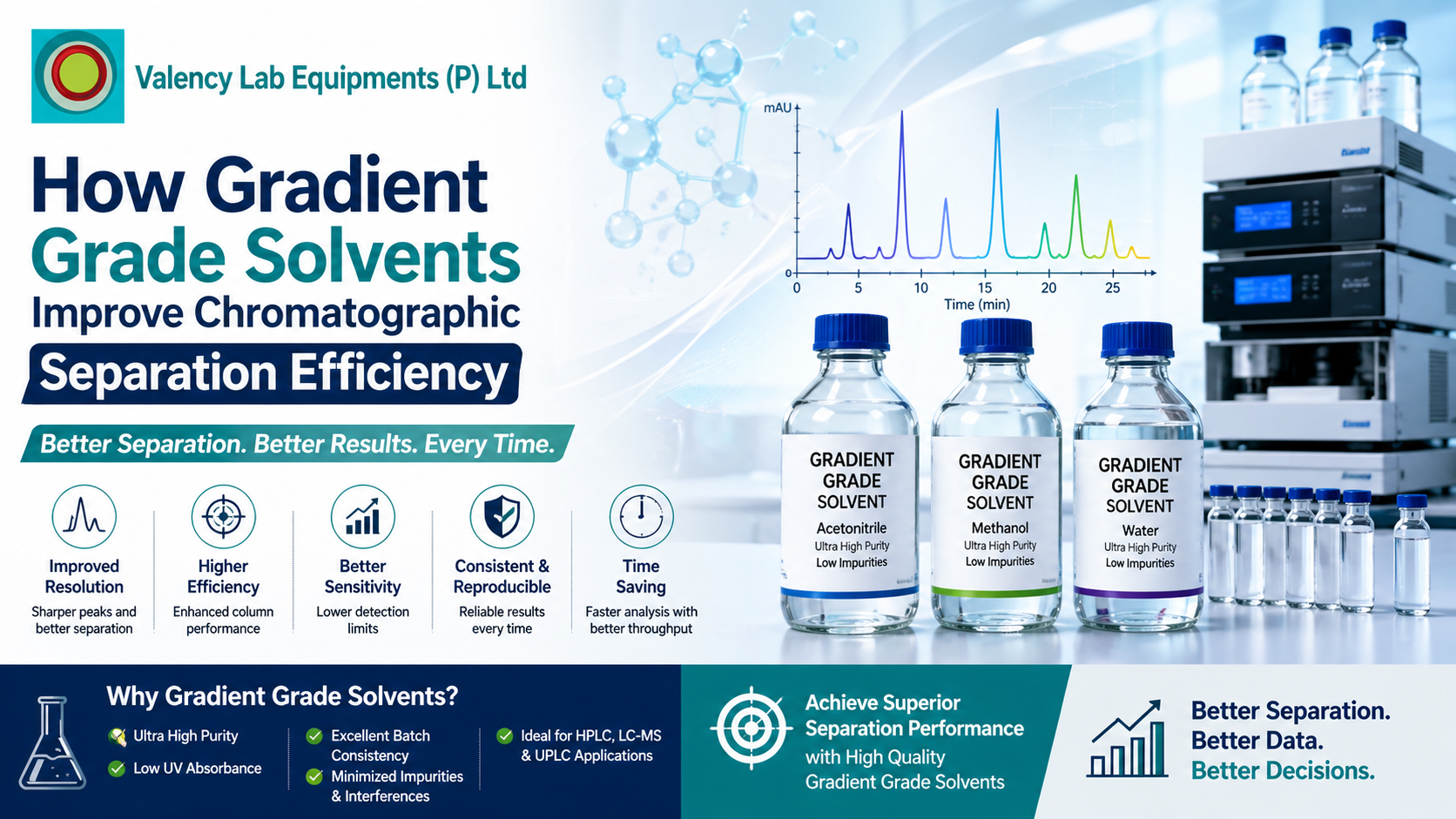
How Gradient Grade Solvents Improve Chromatographic Separation Efficiency
Introduction
Gradient Grade Solvents are specifically designed to improve separation efficiency in advanced chromatography systems like HPLC and LC-MS.
Chromatography is one of the most important techniques used in analytical laboratories today. It helps scientists separate, identify, and analyze different compounds in a mixture. Whether it is pharmaceuticals, food testing, or environmental analysis, accurate separation is critical.
One key factor that directly affects chromatographic performance is the type of solvent used. Among the different solvent types available
But what exactly are gradient grade solvents, and why are they so important?
In simple terms, gradient grade solvents are high-purity solvents optimized for gradient elution techniques. They are manufactured to ensure minimal impurities, low UV absorbance, and consistent composition—making them ideal for precise and sensitive analysis.
Studies show that using proper gradient grade solvents can improve peak resolution by up to 40–60%, especially in complex sample analysis.
In this blog, we will explore how gradient grade solvents improve chromatographic separation efficiency, why they matter, and how to use them effectively.
Table of Contents
1. What Are Gradient Grade Solvents and Why Are They Important?
Related Keyword: high purity solvents for chromatography
To understand the role of Gradient Grade Solvents, we first need to understand gradient elution.
What is Gradient Elution?
In chromatography:
- Isocratic elution uses a constant solvent composition
- Gradient elution changes solvent composition over time
Gradient elution is used when:
- Samples are complex
- Compounds have different polarities
What Makes Gradient Grade Solvents Different?
Gradient grade solvents are specially designed to:
- Maintain consistent composition during gradients
- Minimize baseline noise
- Avoid interference in detection
Know More about: high purity solvents for chromatography
Key Features of Gradient Grade Solvents
- Ultra-high purity
- Low UV absorbance
- Minimal impurities
- Stable composition
These features ensure that the solvent does not interfere with detection, especially in UV and MS systems.
Why Regular Solvents Are Not Enough
Using regular solvents in gradient systems can cause:
- Baseline drift
- Noise fluctuations
- Poor reproducibility
This happens because:
- Impurities change during gradient shifts
- Detection becomes unstable
Impact on Chromatographic Efficiency
Gradient grade solvents improve:
- Peak resolution
- Sensitivity
- Reproducibility
Data Insight
- Proper solvent selection can improve separation efficiency by up to 50%
- Gradient grade solvents reduce baseline noise significantly
Key Takeaway
Gradient grade solvents are essential for modern chromatography systems where precision and sensitivity are critical.
2. How Gradient Grade Solvents Enhance Separation and Peak Resolution
Related Keyword: chromatography separation efficiency
The main goal of chromatography is to achieve clear and distinct separation of compounds. This is where gradient grade solvents play a major role.
1. Improved Peak Resolution
Peak resolution refers to how well two compounds are separated.
With gradient grade solvents:
- Peaks are sharper
- Overlapping is reduced
- Identification becomes easier
👉 Internal Link: chromatography separation efficiency
2. Reduced Baseline Noise
Baseline noise can hide important signals.
Gradient grade solvents:
- Have fewer impurities
- Provide a stable baseline
This improves:
- Signal-to-noise ratio
- Detection accuracy
3. Better Gradient Reproducibility
In gradient elution:
- Solvent composition changes continuously
If solvents are not consistent:
- Results vary between runs
Gradient grade solvents ensure:
- Consistent gradients
- Repeatable results
4. Faster Analysis Time
Efficient separation means:
- Faster run times
- Higher throughput
This is important in:
- Pharmaceutical labs
- Quality control
5. Enhanced Detection Sensitivity
Cleaner solvents lead to:
- Stronger signals
- Lower detection limits
Real-World Example
In drug analysis:
- Complex mixtures require precise separation
- Gradient grade solvents help isolate each compound clearly
Data Insight
- Peak resolution improvement: 40–60%
- Noise reduction: up to 30%
Key Takeaway
Better solvents lead to better separation, which leads to more accurate results.
3. Best Practices for Using Gradient Grade Solvents in Chromatography
Related Keyword: LC-MS solvent selection
Using gradient grade solvents correctly is just as important as choosing them.
1. Choose the Right Solvent Combination
Common gradient systems use:
- Water + Methanol
- Water + Acetonitrile
Know More: LC-MS solvent selection
2. Maintain Proper Solvent Quality
Always:
- Use fresh solvents
- Avoid contamination
3. Degassing and Filtration
Before use:
- Filter solvents
- Remove dissolved gases
This prevents:
- Bubble formation
- Noise issues
4. Proper Storage
Store solvents:
- In clean containers
- Away from light
- At stable temperatures
5. System Maintenance
Ensure:
- Clean columns
- Proper calibration
- Regular maintenance
6. Optimize Gradient Conditions
Adjust:
- Flow rate
- Gradient profile
- Temperature
Common Mistakes to Avoid
- Using non-gradient solvents
- Ignoring solvent quality
- Poor system maintenance
Performance Benefits
Using best practices can:
- Improve efficiency by 30–50%
- Increase reproducibility
- Reduce errors
Key Takeaway
Correct usage of gradient grade solvents ensures maximum performance.
Conclusion
Gradient grade solvents play a crucial role in improving chromatographic separation efficiency. They are specially designed to handle the challenges of gradient elution, providing cleaner baselines, better peak resolution, and more reliable results.
From improving sensitivity to ensuring reproducibility, these solvents are essential for modern analytical applications.
In summary:
- Gradient grade solvents improve separation
- They reduce noise and interference
- They enhance accuracy and efficiency
In simple terms:
👉 Better solvents = Better separation = Better results
If you want high-quality chromatography results, using gradient grade solvents is not optional—it’s necessary.
FAQs
1. What are gradient grade solvents?
They are high-purity solvents designed for gradient chromatography.
2. Why are gradient grade solvents important?
They improve separation efficiency, reduce noise, and enhance accuracy.
3. Can I use regular solvents for gradient elution?
Not recommended, as they may cause noise and poor reproducibility.
4. What solvents are commonly used in gradients?
Water, methanol, and acetonitrile are commonly used.
5. How do gradient solvents improve peak resolution?
They provide stable composition and reduce interference.
6. Do gradient solvents improve sensitivity?
Yes, they reduce noise and improve signal detection.