
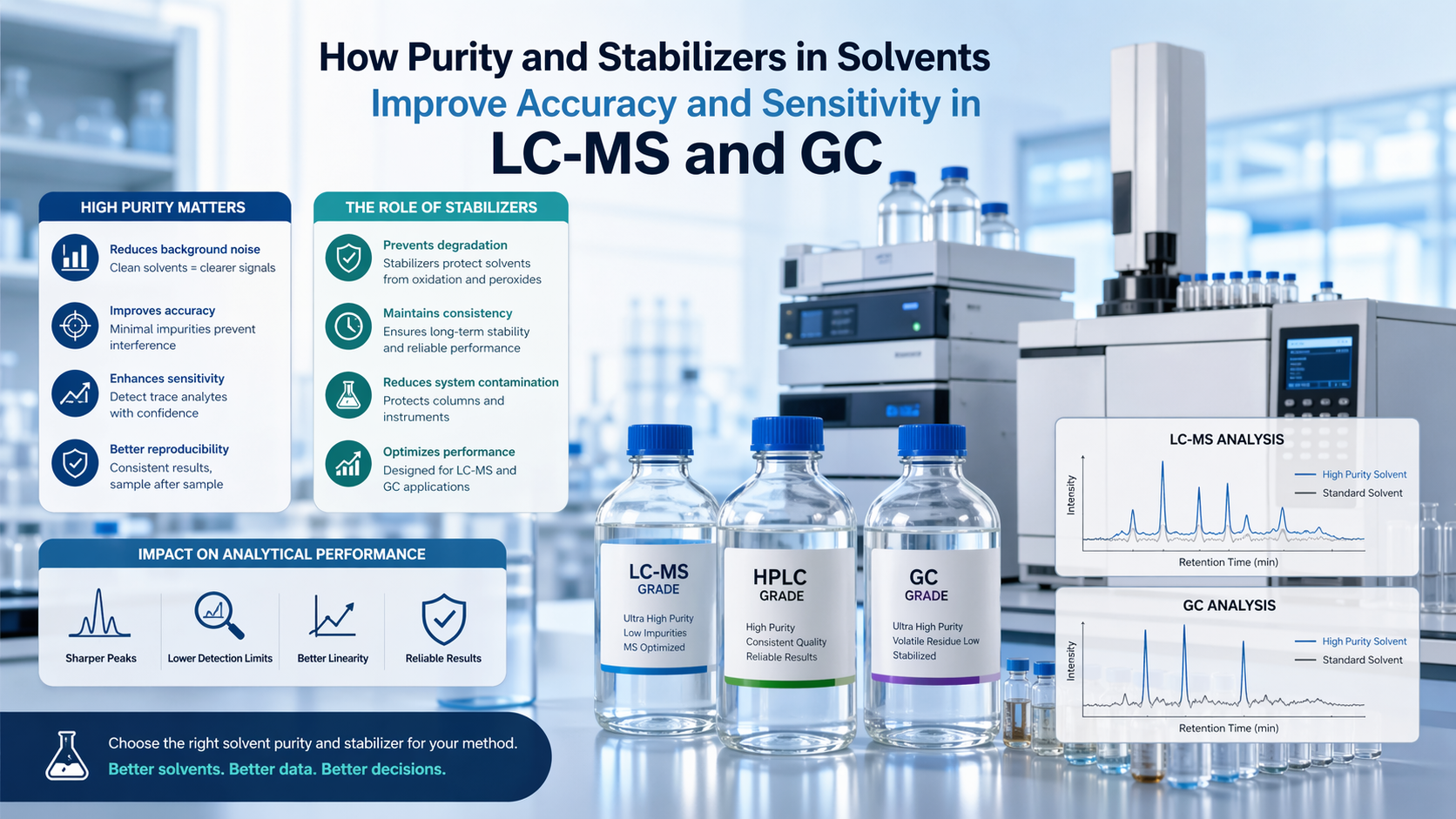
How Chromasolv Solvents Improve Accuracy and Sensitivity in LC-MS and GC
Table of Contents
Introduction
In modern analytical laboratories, achieving high accuracy and sensitivity is critical, especially when working with trace-level compounds. Techniques like LC-MS (Liquid Chromatography-Mass Spectrometry) and GC (Gas Chromatography) rely heavily on solvent quality. Even minor impurities or unstable compositions can lead to noise, poor peak resolution, and inaccurate results.
This is where Chromasolv solvents for LC-MS and GC play a crucial role. These solvents are specially designed with high purity levels and controlled stabilizers to ensure consistent and reliable analytical performance. According to the Chromasolv™ product documentation, these solvents are widely used in applications such as pesticide analysis, drug discovery, metabolite identification, and impurity quantification at trace levels .
In this blog, we will explore how purity levels and stabilizers in Chromasolv™ solvents directly impact analytical accuracy and sensitivity, and why choosing the right solvent grade can significantly improve your results.
1. Role of Purity Levels in Chromasolv™ Solvents for LC-MS and GC Accuracy
Related Keyword: high purity solvents for chromatography
Purity is one of the most critical factors in analytical chemistry. When using Chromasolv solvents for LC-MS and GC, higher purity directly translates into better accuracy and lower background noise.
Why Purity Matters
In LC-MS and GC systems, even trace impurities can:
- Interfere with analyte detection
- Cause ghost peaks
- Reduce signal-to-noise ratio
- Affect reproducibility
Chromasolv™ solvents are manufactured with ≥99.9% purity levels for many applications, ensuring minimal contamination.
Impact on LC-MS Performance
LC-MS is extremely sensitive, often detecting compounds at parts-per-billion (ppb) or even parts-per-trillion (ppt) levels. Low-purity solvents can introduce:
- Ion suppression
- Background ion interference
- Reduced detection sensitivity
Chromasolv™ LC-MS and LC-MS Ultra grades are specifically designed to minimize such issues. These solvents are tested for UHPLC-MS compatibility, ensuring they do not introduce interfering ions.
Impact on GC Performance
In GC analysis, impurities in solvents can:
- Produce additional peaks
- Affect retention times
- Distort chromatograms
Chromasolv™ GC-grade solvents are optimized for:
- Volatile organic compound analysis
- Pesticide residue detection
- Environmental testing
Data Insight
Studies show that using high-purity solvents can improve signal-to-noise ratios by up to 30–50%, significantly enhancing detection limits in trace analysis.
Key Takeaway
Using high purity solvents for chromatography like Chromasolv™ ensures:
- Accurate peak identification
- Improved reproducibility
- Lower detection limits
2. How Stabilizers in Chromasolv™ Solvents Affect Analytical Sensitivity
Related Keyword: solvent stabilizers in chromatography
While purity is essential, stabilizers also play a critical role in maintaining solvent performance over time.
What Are Stabilizers?
Stabilizers are additives used to:
- Prevent solvent degradation
- Avoid peroxide formation
- Maintain chemical stability
For example, the Chromasolv™ catalog mentions solvents like chloroform containing ethanol or amylene as stabilizers .
Positive Impact of Stabilizers
Stabilizers help:
- Extend solvent shelf life
- Prevent formation of reactive by-products
- Maintain consistent analytical performance
This is especially important in long analytical runs or batch testing environments.
Potential Challenges in LC-MS
However, stabilizers can sometimes:
- Suppress ionization
- Introduce background signals
- Interfere with sensitive mass detection
That’s why Chromasolv™ offers:
- Stabilizer-free options
- LC-MS specific formulations with controlled additives
For example:
- Methanol with 0.1% formic acid improves ionization efficiency
- Ammonium acetate enhances buffering capacity
Impact on GC Analysis
In GC:
- Stabilizers prevent solvent breakdown during heating
- Ensure stable baseline signals
- Reduce column contamination
Best Practice
Choose solvents based on application:
- LC-MS: Use low additive or MS-grade solvents
- GC: Stabilized solvents improve thermal stability
Key Takeaway
Proper use of solvent stabilizers in chromatography improves:
- Sensitivity
- Stability
- Instrument lifespan
👉 Internal Link: solvent stabilizers in chromatography
3. Choosing the Right Chromasolv™ Grade for Maximum Performance
Related Keyword: LC-MS solvent grade vs HPLC grade
Not all solvents are the same. Chromasolv™ offers multiple grades tailored for specific analytical needs.
Types of Chromasolv™ Solvents
According to the product catalog, the range includes:
- Standard HPLC grade
- Gradient grade
- LC-MS grade
- LC-MS Ultra grade
- GC and GC-headspace grade
Why Grade Selection Matters
Using the wrong solvent grade can:
- Reduce sensitivity
- Increase noise
- Damage instruments
LC-MS vs HPLC Grade
| Feature | HPLC Grade | LC-MS Grade |
|---|---|---|
| Purity | High | Ultra-high |
| Ion suppression | Possible | Minimal |
| Additives | May contain UV stabilizers | MS-compatible additives |
| Sensitivity | Moderate | Very high |
LC-MS Ultra Advantage
Chromasolv™ LC-MS Ultra solvents are:
- Tested for UHPLC-MS systems
- Designed for trace-level detection
- Ideal for metabolomics and drug discovery
GC-Specific Solvents
GC-grade solvents are optimized for:
- Volatility
- Low residue
- Thermal stability
Applications include:
- Pesticide residue analysis
- Environmental monitoring
- Forensic testing
Industry Applications
Chromasolv™ solvents are used in:
- Pharmaceutical analysis
- Food safety testing
- Environmental monitoring
- Bioanalytical research
Data Insight
Using LC-MS grade solvents can improve detection limits by up to 10x compared to standard HPLC solvents in sensitive applications.
Key Takeaway
Choosing the right LC-MS solvent grade vs HPLC grade ensures:
- Maximum sensitivity
- Accurate quantification
- Reliable results
👉 Internal Link: LC-MS solvent grade vs HPLC grade
Conclusion
The performance of analytical techniques like LC-MS and GC depends heavily on solvent quality. Chromasolv solvents for LC-MS and GC stand out because of their carefully controlled purity levels and stabilizer compositions.
High purity ensures minimal interference, better signal clarity, and improved detection limits. Stabilizers, when properly selected, enhance solvent stability without compromising sensitivity. Additionally, choosing the correct solvent grade—whether LC-MS, GC, or HPLC—ensures optimal performance for specific applications.
As analytical demands continue to grow, especially in pharmaceuticals, environmental testing, and food safety, the importance of using high-quality solvents like Chromasolv™ cannot be overstated.
In simple terms:
👉 Better solvents = Better data = Better decisions
FAQs
1. What are Chromasolv™ solvents used for?
Chromasolv™ solvents are used in LC-MS, GC, HPLC, and other analytical techniques for high-precision chemical analysis.
2. Why is solvent purity important in LC-MS?
High purity reduces background noise and improves sensitivity, allowing detection of trace-level compounds.
3. Do stabilizers affect LC-MS results?
Yes, some stabilizers can suppress ionization. That’s why LC-MS grade solvents are designed with controlled additives.
4. What is the difference between LC-MS and HPLC solvents?
LC-MS solvents are more pure and optimized to avoid ion suppression, while HPLC solvents focus on UV detection.
5. Can I use GC solvents for LC-MS?
No, GC solvents are optimized for volatility and may not be suitable for LC-MS sensitivity requirements.
6. Which Chromasolv™ solvent is best for trace analysis?
LC-MS Ultra grade solvents are best for trace-level detection and high-sensitivity applications.