
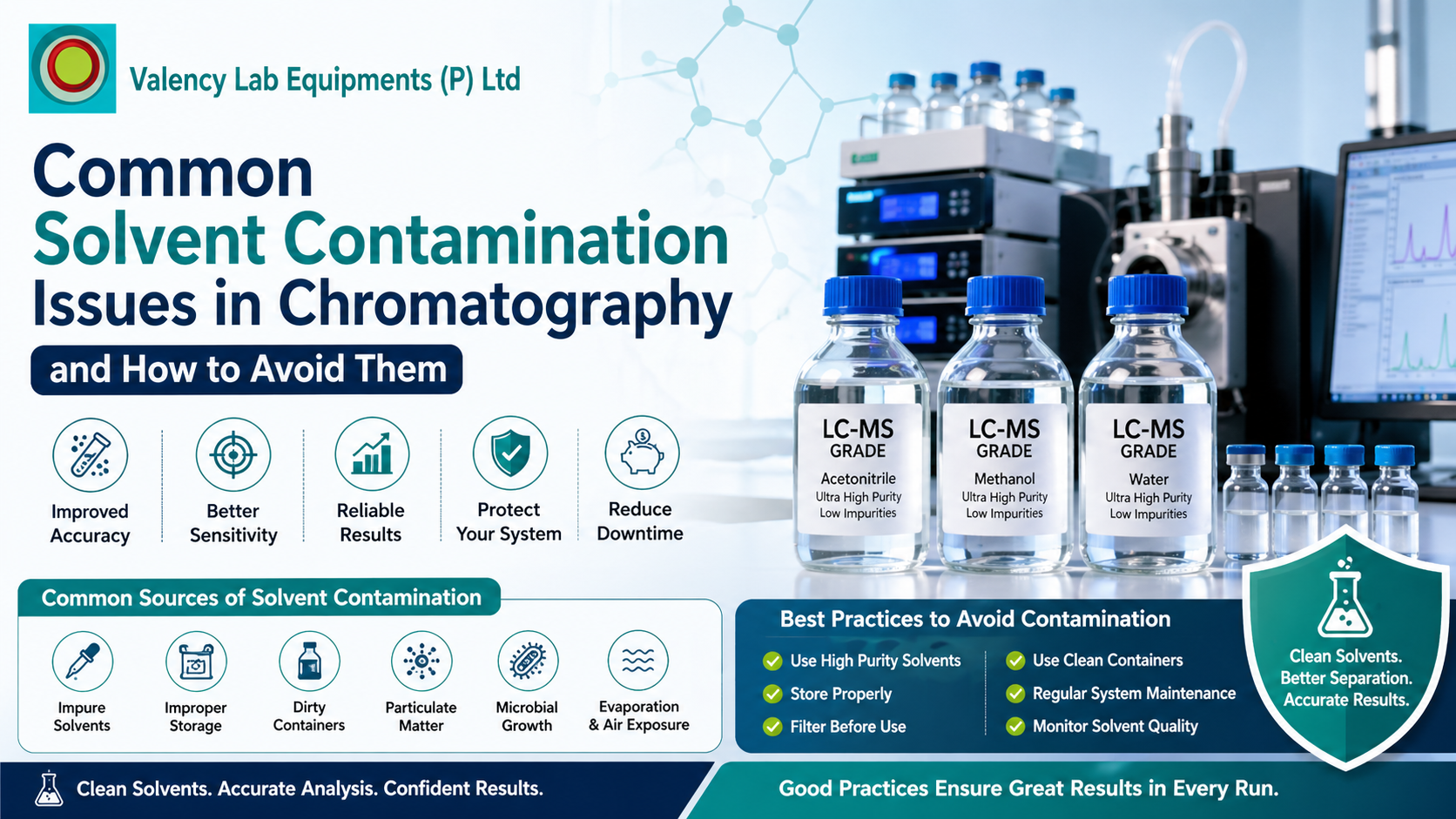
Common Solvent Contamination Issues in Chromatography and How to Avoid Them
Introduction
One of the most common problems labs face is solvent contamination in chromatography.
Chromatography techniques like LC-MS (Liquid Chromatography–Mass Spectrometry) and GC (Gas Chromatography) are widely used in modern laboratories for accurate chemical analysis. These techniques are highly sensitive, which means even small errors can affect results.
Solvents are the backbone of chromatographic analysis. If they are contaminated, they can introduce noise, create false peaks, reduce sensitivity, and even damage instruments. Studies show that solvent contamination can reduce analytical accuracy by up to 30–60%, especially in trace-level analysis.
The problem is that contamination is not always visible. Even trace impurities can interfere with detection and lead to incorrect conclusions.
In this blog, we will explore the most common solvent contamination issues in chromatography and provide simple, practical ways to avoid them.
Table of Contents
1. Types of Solvent Contamination in Chromatography and Their Impact
Related Keyword: solvent purity in LC-MS
Understanding different types of contamination is the first step to solving the problem of solvent contamination in chromatography.
1. Organic Impurities
Organic contaminants are one of the most common issues.
Sources:
- Low-quality solvents
- Improper storage
- Exposure to air
Impact:
- Extra peaks in chromatograms
- Increased baseline noise
- Reduced signal clarity
👉 Internal Link: solvent purity in LC-MS
2. Water Contamination
Even small amounts of water can affect chromatography.
In LC-MS:
- Changes mobile phase composition
- Affects ionization
In GC:
- Causes poor peak shape
- Damages columns
3. Non-Volatile Residues
These are impurities that do not evaporate.
Impact:
- Build-up in columns
- Ghost peaks
- Reduced column life
4. Particulate Contamination
Particles can enter solvents through:
- Dust
- Dirty containers
- Poor filtration
Impact:
- Blocked tubing
- Increased system pressure
- Instrument damage
5. Microbial Contamination
This is common in water-based solvents.
Impact:
- Degradation of solvents
- Variable results
- System contamination
Data Insight
- Around 40% of chromatography issues are linked to contamination
- High-purity solvents can reduce errors by up to 50%
Key Takeaway
Different types of contamination affect chromatography in different ways, but all lead to reduced accuracy and sensitivity.
2. How Solvent Contamination Affects Sensitivity, Accuracy, and Results
The biggest impact of solvent contamination in chromatography is on analytical performance.
1. Reduced Signal-to-Noise Ratio
In chromatography:
- Signal = analyte
- Noise = background interference
Contaminated solvents:
- Increase noise
- Reduce signal clarity
Learn More: signal-to-noise ratio in LC-MS
2. False Peaks and Ghost Peaks
Impurities can create:
- Additional peaks
- Misleading data
This can lead to:
- Incorrect identification
- Wrong conclusions
3. Ion Suppression in LC-MS
In LC-MS:
- Contaminants compete during ionization
- Reduce analyte signal
This can reduce sensitivity by up to 80%
4. Poor Reproducibility
Contaminated solvents cause:
- Inconsistent results
- Variation between runs
5. Increased Detection Limits
Detection limit is the smallest amount you can detect.
Contamination:
- Raises detection limits
- Makes trace analysis difficult
6. Instrument Damage
Long-term contamination can:
- Damage columns
- Block systems
- Increase maintenance costs
Real-World Example
In pharmaceutical testing:
- Contaminated solvents can lead to incorrect drug purity results
- This can cause compliance issues
Data Insight
- Poor solvent quality can reduce sensitivity by 30–70%
- Clean solvents improve reproducibility significantly
Key Takeaway
Contamination directly affects:
- Sensitivity
- Accuracy
- Reliability
3. Best Practices to Prevent Solvent Contamination in Chromatography
Related Keyword: high purity solvents for chromatography
Preventing solvent contamination in chromatography is possible with simple steps.
1. Use High-Purity Solvents
Always use:
- LC-MS grade solvents
- GC-grade solvents
These are designed to:
- Minimize impurities
- Improve performance
Learn More: high purity solvents for chromatography
2. Proper Storage
Store solvents:
- In sealed containers
- Away from light and heat
- In clean environments
3. Use Filtration
Filter solvents to remove:
- Particles
- Contaminants
Use:
- 0.2 µm or 0.45 µm filters
4. Avoid Cross-Contamination
Do not:
- Mix old and new solvents
- Use dirty containers
- Reuse solvent bottles
5. Maintain Clean Equipment
Regularly clean:
- Tubing
- Columns
- Detectors
6. Use Fresh Solvents
Old solvents can:
- Degrade
- Absorb contaminants
Always use fresh solvents for critical analysis.
7. Monitor Solvent Quality
Check for:
- Changes in color
- Unexpected peaks
- Increased noise
8. Control Environment
Keep lab conditions:
- Clean
- Dust-free
- Temperature-controlled
Performance Benefits
Following these practices can:
- Improve sensitivity by 30–50%
- Reduce instrument downtime
- Increase data reliability
Common Mistakes to Avoid
- Using low-grade solvents
- Ignoring storage conditions
- Skipping filtration
Key Takeaway
Prevention is easier than correction—good practices ensure better results.
Conclusion
Solvent contamination in chromatography is one of the most common yet overlooked problems in analytical labs. It can affect everything from signal clarity to detection limits and overall data accuracy.
The most common contamination sources include:
- Organic impurities
- Water
- Non-volatile residues
- Particles
- Microbial growth
These issues can lead to:
- Increased noise
- False peaks
- Reduced sensitivity
The good news is that contamination can be easily avoided by:
- Using high-purity solvents
- Proper storage and handling
- Regular system maintenance
In simple terms:
👉 Clean solvent = Accurate results
👉 Contaminated solvent = Unreliable data
By following best practices, you can significantly improve your chromatography performance and ensure reliable results every time.
FAQs
1. What is solvent contamination in chromatography?
It refers to impurities in solvents that affect analytical results.
2. How does contamination affect LC-MS?
It causes ion suppression, noise, and reduced sensitivity.
3. What are ghost peaks?
They are unwanted peaks caused by contaminants.
4. How can I avoid solvent contamination?
Use high-purity solvents, proper storage, and filtration.
5. Why is solvent purity important?
It improves accuracy, sensitivity, and reproducibility.
6. Can contamination damage instruments?
Yes, it can clog systems and reduce instrument life.