
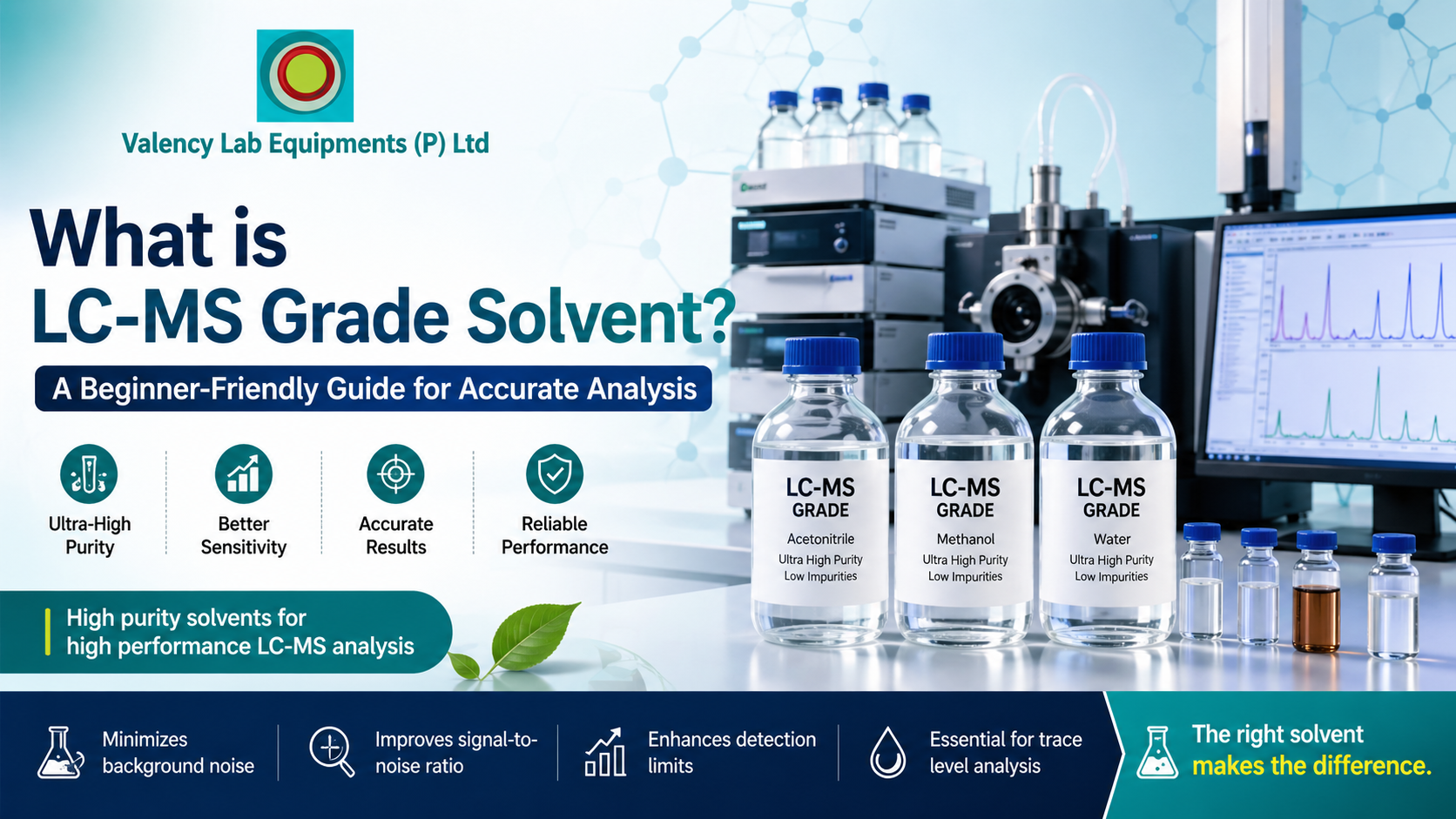
What is LC-MS Grade Solvent? A Beginner-Friendly Guide for Accurate Analysis
Introduction
In modern laboratories, precision and accuracy are everything. Whether you are working in pharmaceuticals, food safety, environmental testing, or research, even the smallest error can lead to incorrect results. One of the most important—but often overlooked—factors in analytical testing is the quality of solvents used.
This is where LC-MS grade solvent becomes essential.
LC-MS (Liquid Chromatography–Mass Spectrometry) is a highly sensitive technique used to detect and quantify compounds at very low concentrations, sometimes even at parts-per-billion (ppb) or parts-per-trillion (ppt) levels. At this level of sensitivity, even tiny impurities in solvents can affect results.
That’s why scientists use LC-MS grade solvent, which is specially designed to:
- Minimize impurities
- Reduce background noise
- Improve signal clarity
Studies show that using high-purity LC-MS solvents can improve detection sensitivity by up to 40–60%, especially in trace-level analysis.
In this beginner-friendly guide, we will explain what LC-MS grade solvents are, why they are important, and how to choose the right one for accurate analysis.
Table of Contents
1. What is LC-MS Grade Solvent and How is it Different from Other Solvents?
Related Keyword: LC-MS solvent grade vs HPLC grade
A LC-MS grade solvent is a high-purity solvent specifically designed for use in liquid chromatography–mass spectrometry. It is manufactured and tested to ensure it does not interfere with ionization or detection.
Key Characteristics of LC-MS Grade Solvents
- Ultra-high purity (typically ≥99.9%)
- Low UV absorbance
- Minimal non-volatile residues
- Free from ion-suppressing contaminants
These properties ensure that the solvent does not produce unwanted signals in the mass spectrometer.
Difference Between LC-MS and HPLC Grade Solvents
Many beginners confuse LC-MS solvents with HPLC solvents. While both are high quality, they are not the same.
| Feature | HPLC Grade | LC-MS Grade |
|---|---|---|
| Purity | High | Ultra-high |
| Detection Focus | UV detection | Mass detection |
| Ion Suppression | Possible | Minimized |
| Background Noise | Moderate | Very low |
Why LC-MS Requires Higher Purity
LC-MS detects ions. If the solvent contains impurities:
- These impurities can ionize
- They create background signals
- They interfere with analyte detection
This leads to:
- Lower sensitivity
- Poor accuracy
- Incorrect results
Common LC-MS Solvents
Some widely used LC-MS grade solvents include:
- Methanol
- Acetonitrile
- Water (ultra-pure)
These solvents are often combined with additives like formic acid to improve ionization.
Key Takeaway
LC-MS grade solvents are not just “cleaner”—they are specifically engineered to support accurate mass spectrometry analysis.
2. Why LC-MS Grade Solvent is Critical for Accuracy and Sensitivity
The performance of an LC-MS system depends heavily on solvent quality. Using the wrong solvent can drastically affect results.
Impact on Signal-to-Noise Ratio
In LC-MS:
- Signal = analyte
- Noise = background interference
High-purity solvents:
- Reduce noise
- Improve signal clarity
This leads to a better signal-to-noise ratio.
Effect on Ionization Efficiency
LC-MS relies on ionization techniques like:
- Electrospray Ionization (ESI)
- APCI
Impurities in solvents can:
- Compete with analytes
- Suppress ionization
- Reduce signal intensity
This is known as ion suppression.
Data Insight
- Ion suppression can reduce signal intensity by up to 80%
- High-purity solvents significantly reduce this issue
Effect on Detection Limits
Detection limit refers to the smallest amount of a compound that can be detected.
With low-quality solvents:
- Detection limits increase
- Trace compounds may go undetected
With LC-MS grade solvents:
- Detection limits decrease
- Trace analysis becomes more reliable
Impact on Reproducibility
Inconsistent solvents can lead to:
- Variable results
- Poor repeatability
High-quality solvents ensure:
- Consistent results
- Reliable data across multiple runs
Real-World Applications
LC-MS grade solvents are critical in:
- Drug development
- Clinical diagnostics
- Food contamination testing
- Environmental monitoring
Even small errors can have serious consequences.
Key Takeaway
Using solvent purity in LC-MS ensures:
- High sensitivity
- Accurate quantification
- Reliable results
3. How to Choose the Right LC-MS Grade Solvent for Your Analysis
Related Keyword: high purity solvents for LC-MS
Choosing the right solvent is not just about purity—it’s about compatibility and application.
Factors to Consider
- Purity Level
Always choose solvents with ≥99.9% purity - Application Type
- Drug analysis → ultra-high purity required
- Routine analysis → standard LC-MS grade may be sufficient
- Additives
Common additives include:- Formic acid
- Ammonium acetate
- TFA
Role of Additives
Additives help:
- Improve ionization
- Enhance peak shape
- Increase sensitivity
However, incorrect additives can:
- Suppress signals
- Interfere with results
Storage and Handling Tips
Even the best solvent can degrade if not handled properly.
Best practices:
- Store in clean, sealed containers
- Avoid exposure to air and light
- Use fresh solvents
- Prevent contamination
System Compatibility
Ensure solvents are compatible with:
- LC columns
- Mass spectrometer
- Mobile phase composition
Common Mistakes to Avoid
- Using HPLC solvent instead of LC-MS grade
- Reusing old solvents
- Ignoring contamination
- Using incorrect additives
Performance Benefits
Using the right LC-MS grade solvent provides:
- Up to 50% better sensitivity
- Improved reproducibility
- Lower detection limits
- Reduced instrument maintenance
Industry Insight
In regulated industries, using LC-MS grade solvents is mandatory for:
- Compliance
- Quality assurance
- Accurate reporting
Key Takeaway
Selecting the right high purity solvents for LC-MS ensures:
- Better performance
- Reliable results
- Long-term efficiency
Conclusion
Understanding LC-MS grade solvent is essential for anyone working in analytical chemistry. These solvents are specially designed to meet the high demands of LC-MS systems, ensuring minimal interference and maximum performance.
Using the right solvent improves:
- Signal clarity
- Sensitivity
- Accuracy
On the other hand, poor solvent choice can lead to:
- Noise
- Ion suppression
- Incorrect results
In simple terms:
👉 Better solvent = Better data
If you want accurate, reliable, and reproducible results, investing in high-quality LC-MS grade solvents is not optional—it’s necessary.
FAQs
1. What is LC-MS grade solvent?
It is a high-purity solvent designed for LC-MS analysis, with minimal impurities and interference.
2. Can I use HPLC solvents for LC-MS?
Not recommended, as they may contain impurities that affect ionization.
3. Why is solvent purity important in LC-MS?
It reduces noise and improves sensitivity and accuracy.
4. What are common LC-MS solvents?
Methanol, acetonitrile, and water are commonly used.
5. What causes ion suppression?
Impurities in solvents or samples competing during ionization.
6. How can I improve LC-MS performance?
Use high-purity solvents, proper additives, and maintain clean systems.