
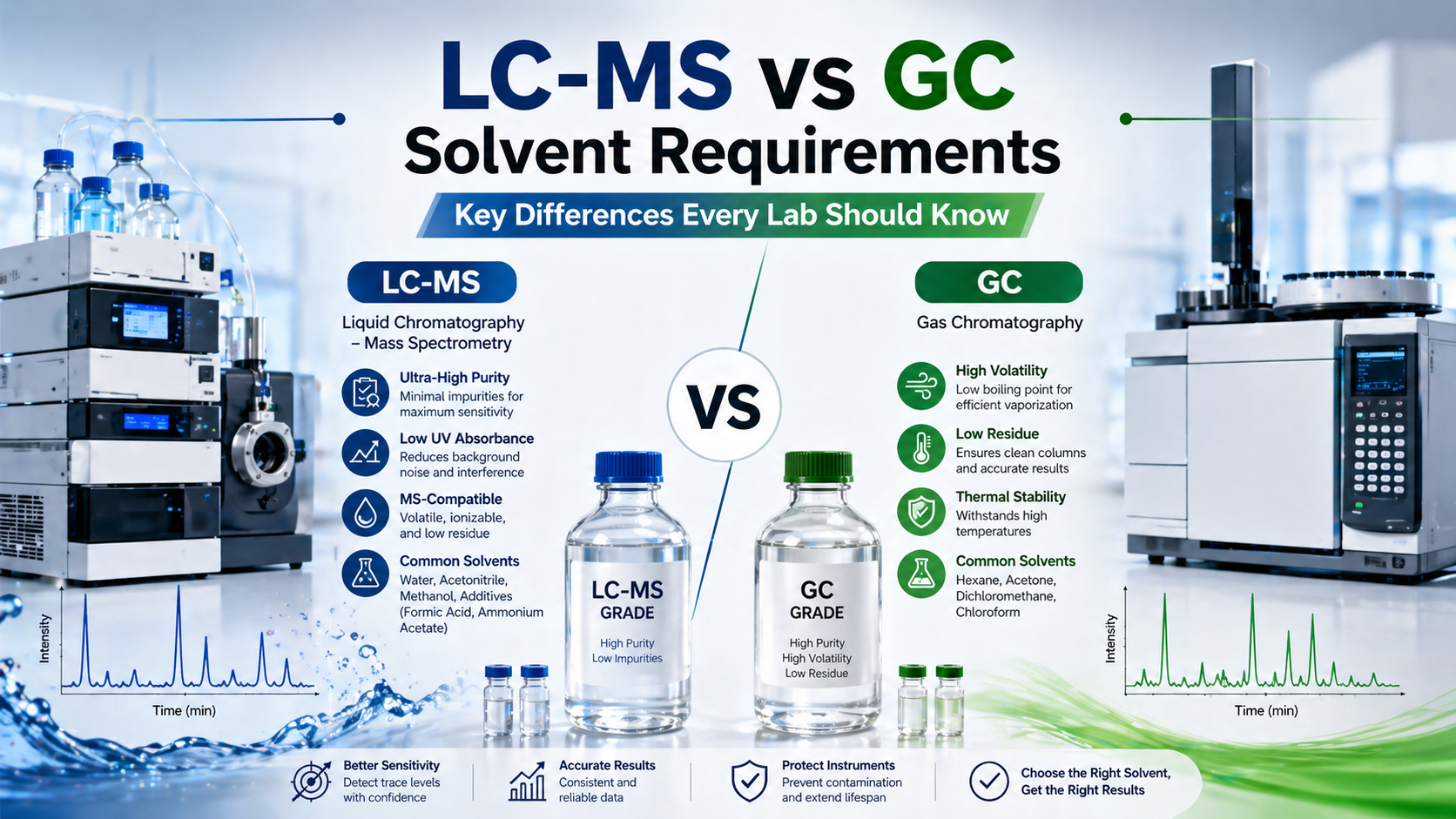
Important LC-MS vs GC Solvent Requirements: Key Differences Every Lab Should Know
Introduction
Understanding LC-MS vs GC solvent requirements is essential In modern analytical laboratories, choosing the right solvent is just as important as choosing the right instrument. Techniques like Liquid Chromatography–Mass Spectrometry (LC-MS) and Gas Chromatography (GC) are widely used for chemical analysis, but they require very different types of solvents.
Table of Contents
Using the wrong solvent can lead to poor sensitivity, noisy data, contamination, and even instrument damage.
Both LC-MS and GC are designed for different types of compounds:
- LC-MS works best for non-volatile, polar, and thermally unstable compounds
- GC is ideal for volatile and thermally stable compounds
Because of these differences, the solvents used in each technique must meet specific criteria such as purity, volatility, and compatibility with detection systems.
Studies show that improper solvent selection can reduce analytical sensitivity by up to 40–70%, especially in trace-level detection.
In this blog, we will break down the major differences between LC-MS and GC solvent requirements in simple terms, helping you choose the right solvent for your application.
1. Purity and Composition Differences in LC-MS vs GC Solvents
One of the biggest differences in LC-MS vs GC solvent requirements is the level of purity needed.
Why Purity Matters in LC-MS
LC-MS is extremely sensitive. It can detect compounds at very low concentrations, sometimes even at parts-per-trillion (ppt) levels.
Because of this:
- Even tiny impurities can interfere with results
- Background noise can increase
- Ion suppression can occur
High-purity solvents are essential to ensure:
- Clean baseline
- Accurate peak detection
- Better signal-to-noise ratio
Purity Requirements in GC
GC also requires pure solvents, but the focus is slightly different:
- Low residue after evaporation
- Minimal non-volatile impurities
- Stable composition under heat
Since GC involves high temperatures, impurities that do not evaporate can:
- Damage the column
- Cause ghost peaks
- Reduce accuracy
Comparison Table
| Feature | LC-MS Solvents | GC Solvents |
|---|---|---|
| Purity Level | Ultra-high | High |
| Sensitivity Requirement | Extremely high | Moderate to high |
| Main Concern | Ion suppression | Residue and volatility |
| Detection Impact | Signal interference | Peak distortion |
Data Insight
- High-purity LC-MS solvents can improve detection sensitivity by up to 50%
- GC solvents with low residue improve column lifespan by 20–30%
Key Takeaway
While both techniques require pure solvents, LC-MS demands ultra-high purity, whereas GC focuses more on low residue and thermal stability.
2. Volatility, Boiling Point, and Stability Requirements
Another major difference in LC-MS vs GC solvent requirements is volatility.
Volatility in GC Solvents
GC works by vaporizing the sample. Therefore, solvents must:
- Evaporate quickly
- Have low boiling points
- Leave no residue
Common GC solvents include:
- Hexane
- Acetone
- Dichloromethane
If a solvent is not volatile enough:
- It may not vaporize properly
- It can damage the column
- It can lead to poor separation
Volatility in LC-MS Solvents
LC-MS does not rely on vaporization in the same way. Instead, it uses liquid mobile phases.
However, volatility still matters because:
- Solvents must evaporate during ionization (ESI/APCI)
- Non-volatile solvents can contaminate the mass spectrometer
Common LC-MS solvents include:
- Methanol
- Acetonitrile
- Water (with additives)
Role of Boiling Point
- GC solvents: Low boiling point is essential
- LC-MS solvents: Moderate volatility is preferred
Stability Requirements
GC solvents must withstand:
- High temperatures (up to 300°C)
LC-MS solvents must:
- Remain stable during ionization
- Avoid forming adducts or interfering ions
Real-World Example
If you use a high-boiling solvent in GC:
- It may not evaporate
- It can damage the system
If you use a non-volatile solvent in LC-MS:
- It can contaminate the ion source
- Reduce sensitivity
Key Takeaway
- GC requires high volatility and thermal stability
- LC-MS requires controlled volatility and ionization compatibility
3. Role of Additives, Stabilizers, and Compatibility in LC-MS vs GC
Additives and stabilizers play very different roles in LC-MS and GC.
Additives in LC-MS Solvents
LC-MS often uses additives to improve ionization.
Common additives include:
- Formic acid
- Ammonium acetate
- Trifluoroacetic acid (TFA)
These additives:
- Enhance ion formation
- Improve peak shape
- Increase sensitivity
Stabilizers in GC Solvents
GC solvents may contain stabilizers to:
- Prevent degradation
- Avoid peroxide formation
- Improve shelf life
For example:
- Chloroform may contain ethanol as a stabilizer
Compatibility with Detection Systems
LC-MS solvents must be:
- MS-compatible
- Free from ion-suppressing contaminants
GC solvents must be:
- Compatible with detectors (FID, ECD, MS)
- Free from non-volatile impurities
Potential Issues
Using the wrong additives can:
- Suppress ionization in LC-MS
- Create unwanted peaks in GC
Industry Applications
LC-MS solvents are used in:
- Drug discovery
- Clinical analysis
- Food safety testing
GC solvents are used in:
- Environmental monitoring
- Forensic analysis
- VOC detection
Data Insight
- Proper use of LC-MS additives can improve signal intensity by 20–60%
- Stabilized GC solvents reduce degradation-related errors significantly
Key Takeaway
- LC-MS relies on additives for performance enhancement
- GC relies on stabilizers for chemical stability
Conclusion
Understanding LC-MS vs GC solvent requirements is essential for any laboratory aiming for accurate and reliable results.
While both techniques require high-quality solvents, their requirements differ significantly:
- LC-MS focuses on ultra-high purity and ionization compatibility
- GC focuses on volatility, thermal stability, and low residue
Choosing the wrong solvent can reduce sensitivity, increase noise, and compromise results. On the other hand, selecting the right solvent improves performance, ensures reproducibility, and protects your instruments.
In simple terms:
👉 LC-MS = Purity + Ionization
👉 GC = Volatility + Stability
Making the right solvent choice is not just a technical decision—it’s a critical factor in achieving high-quality analytical results.
FAQs
1. What is the main difference between LC-MS and GC solvents?
LC-MS solvents require ultra-high purity and ionization compatibility, while GC solvents require high volatility and low residue.
2. Can I use LC-MS solvents in GC?
Not always. LC-MS solvents may not have the required volatility for GC.
3. Why is volatility important in GC solvents?
Because GC requires solvents to vaporize quickly for proper separation.
4. What additives are used in LC-MS solvents?
Common additives include formic acid, ammonium acetate, and TFA.
5. Do GC solvents need stabilizers?
Yes, stabilizers help prevent degradation and improve shelf life.
6. How does solvent choice affect analytical results?
It impacts sensitivity, accuracy, reproducibility, and instrument performance.